WHY PERSONAL SUBMARINES ARE THE ULTIMATE SUPERYACHT TOY
For decades, superyacht innovation played out on the water’s surface: faster tenders, more elaborate helipads, ever-expanding water toy fleets. But the owners and captains shaping the industry today are looking in a different direction: beneath the surface. As the toy lockerof the world’s most ambitious yachts evolves, one category has emerged as the undisputedpinnacle of onboard experience: the personal submarine. And no name has done more to define that category than Triton Submarines.
For captains, crew, and brokers navigating what today’s high-net-worth clients actually want, the shift is worth understanding. Ownership fatigue is real. Many of the world’s most experienced yacht owners, aboard vessels already equipped with helicopters, expansive tender fleets, and full-scale spas, have ticked off the obvious boxes. What they’re chasing now is something rarer: genuine access to a part of the planet almost no one else will ever see. A submersible doesn’t just entertain guests; it transforms a cruise into an expedition. That distinction is exactly why brokers are increasingly finding that a sub in the tender garage moves the needle on a sale, and why crew are being asked to train on systems that, a decade ago, barely existed outside of research vessels.
Built for the Yacht, Not the Other Way Around
The single biggest obstacle to submersible ownership has always been integration. A submarine is only as useful as the ease with which it can be launched, stored, and maintained, and this is where Triton has quietly solved the industry’s hardest engineering problem.The Triton 1650/3 LP was designed from the outset to answer a practical question captains ask before any other: will it fit? Its low-profile hull was engineered to slide into a standard tender garage without triggering a structural refit, meaning a yacht can add a genuine 500-meter-rated exploration vessel without sacrificing deck space or existing tender capacity. For a pilot and two guests at a time, it delivers an unbroken, distortion-free view through its acrylic sphere, piloted through controls intuitive enough that a first-time guest can feel confident within minutes. 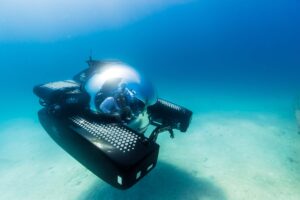
For owners and management companies weighing whether a subis a feasible addition to an existing yacht, the 1650/3 LP has become the default answer. Where the LP is about seamless integration, the Triton 1650/7 C is about ambition. Built to carry a pilot and six guests at once, it was conceived as the first true “social submersible” avessel spacious enough that a dive becomes a shared occasion rather than a solitary thrill. Its wide acrylic canopy and open interior lend it the feel of an underwater lounge, making it a natural fit for charter operations, family yachts, and any owner who sees entertaining as central to the onboard experience.
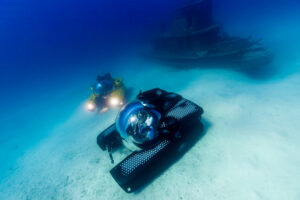
It still dives to 500 meters with the stability and endurance Triton is known for, but its real innovation is social, not mechanical. It reframes the submarine from a solo adventurer’s toy into a centerpiece experience for the whole guest list.For those chasing depth rather than headcount, the Triton 3300/6 extends the range considerably. Rated to 1,000 meters and built for a pilot and five guests, it opens up genuine expedition-grade access to hydrothermal vents, deep reef systems, and wreck sites well beyond recreational diving limits, without asking owners to compromise on comfort or the clarity of Triton’s signature acrylic sphere. It is, in effect, the bridge between superyacht luxury and serious oceanographic capability.
Why Design Pedigree Matters
None of this would carry the same weight in the brokerage world without the design credibility behind it. Triton’s collaboration with Espen Øino, arguably the most influential name in contemporary yacht design, has ensured that its submersibles are conceived as an extension of the mothership rather than an add-on. A Triton sub sitting in a garage or displayed on deck reads as intentional, not incidental, because its lines were considered alongside the yacht’s own from the start.More recently, Marc Newson, known for shaping the visual identity of Apple, Louis Vuitton, and Qantas, has brought his sculptural sensibility to Triton’s interiors and forms. The result is a vessel that feels less like equipment and more like a considered environment: refined, futuristic, and unmistakably premium. For brokers, this pedigree matters in a very concrete way. It’s the difference between selling a “feature” and selling a collectible object with its own design story, one that photographs well, markets well, and holds its value.
 The Business Case, Not Just the Wow Factor
For captains and management teams, the practical argument matters as much as the emotional one. Triton’s engineering-first approach to fit and safety keeps crew training and day-to-day operation more approachable than the category’s reputation suggests, and servicing runs through two dedicated facilities, headquarters in Sebastian, Florida, and the EMEA support center in Barcelona, Spain, giving crews reliable access wherever a yacht is operating. For brokers, a submersible signals that a yacht is outfitted for genuine exploration, not just entertainment, a distinction that resonates with the next generation of owners.
The Ultimate Toy, Redefined
The superyacht industry has always sold experience over possession, but few additions deliver on that promise as completely as a personal submarine. It offers guests something that no water toy fleet or onboard cinema ever could: access to a world that remains, even now, almost entirely unexplored. As more owners chase that sense of genuine discovery, and more brokers and captains recognize the operational and commercial case for it, Triton’s position at the top of the category looks less like a trend and more like a permanent shift in what “the ultimate superyacht toy” means.To explore the full range of Triton submersibles and discuss options for your yacht, visit tritonsubs.com or meet the team at the Monaco Yacht Show Stand QA-17.