ONBOARD cornered Les Annan – Captain, Unlimited Chief Engineer, Submarine Pilot, and Submarine Repair Technician – to chat about life at the helm, under the hull, and everything in between
 What first drew you to yachting?
My fascination with the ocean started early—when I saw Jacques Cousteau on TV at six years old, I knew I had to become a scuba diver. I was certified at 12 and working in a dive shop in Denver soon after. By 18, I was a dive instructor, but I knew Colorado wasn’t where I wanted to stay.
I moved to Saint Thomas in the U.S. Virgin Islands and took a job at a dive shop, which quickly led to working aboard liveaboard dive boats. I spent ten incredible years on the sailing vessel Cuan Law, exploring the Caribbean and even spending a year diving in the Galápagos. During that time, I earned my USCG 3,000 Ton Oceans Master and Engineer licenses.
It was in those anchorages, watching motor yachts glide in, that I saw another path opening up. I’d look at those big white boats and think, That’s where I’m headed next. That curiosity—and my time at sea—led me into the world of superyachts.
How has being both captain AND engineer changed how you run a boat?
Spending three years as Chief Engineer on a 100-meter supply vessel gave me invaluable technical insight—and earned me my Chief Engineer Unlimited license. Now, as a captain, that background helps me bridge the gap between departments.
I trust my Chief Engineer to run their team, but they know I can step in when needed. It means we troubleshoot faster, communicate better, and find more practical solutions. It also gives me the ability to speak clearly with owners during technical issues—breaking things down simply and offering reassurance when it counts.
What was your first sub dive like?
As a kid, I had a cardboard submarine I’d sit in, imagining deep-sea adventures. So when I finally got to do a real sub dive, it felt like stepping into a childhood dream.
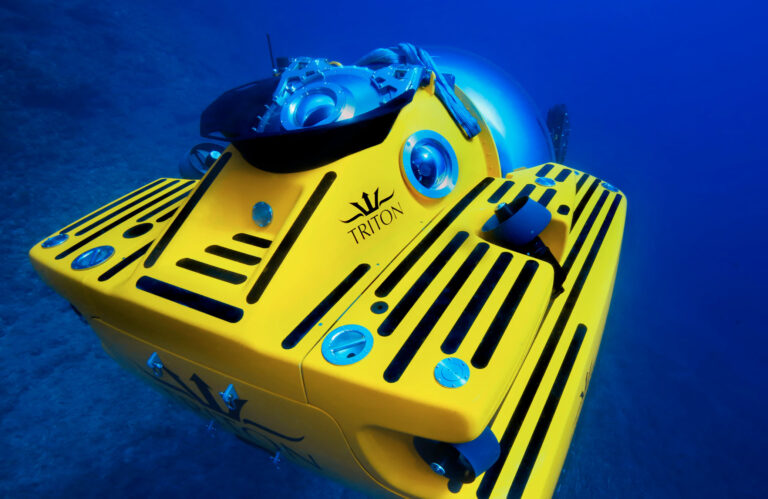
We descended in a three-person sub capable of reaching 1,000 meters. It was incredibly peaceful—just the hum of the sub as the light faded around us. By 300 meters, I realised we were likely entering a part of the ocean no human had ever seen.
It was humbling, like exploring an alien world that’s been hidden for millions of years. It reminded me exactly why I fell in love with the ocean in the first place.
Most unforgettable thing you’ve seen underwater?
One dive still gives me chills. We were at around 900 meters on a previously unexplored site when a massive deep-sea octopus appeared—gliding silently past the dome, completely unbothered by us. Its movements were almost balletic, and for a moment, everything just stopped. No sound, no current—just this extraordinary creature in its element.
It was like witnessing another world. Humbling, surreal, and something I’ll never forget.
What’s the biggest risk when piloting a sub?
Despite what people think, modern subs are incredibly safe—fully certified, rigorously tested, and packed with built-in redundancies. Honestly, I feel safer in a sub at 1,000 meters than I do driving on the highway.
The real risk lies in awareness—knowing your surroundings and the seabed topography to avoid entanglements or unexpected contact. But when operated responsibly, the danger is minimal—and the experience is extraordinary.
Any near-misses?
Thankfully, no. That’s down to strong systems and, more importantly, a highly professional team. From topside support to pilots and techs, everyone’s trained, focused, and disciplined—which keeps the margin for error exactly where it should be: minimal.
What tech has made the biggest impact on your job?
I still remember navigating with a sextant on my first trip to the Galápagos—no GPS, just patience and pencil lines on a chart. So for me, the real game-changer has been navigation tech. GPS, AIS, electronic charts, real-time weather routing—it’s transformed how we operate. Safer, faster, and more efficient. Having that kind of data at your fingertips makes a huge difference, and I never take it for granted.
Are subs getting easier, or harder to manage?
With Triton subs, managing a submersible program has become significantly easier, mainly thanks to better tech and stronger support systems. From maintenance to launch logistics, everything’s becoming more streamlined.
With the right team and proper procedures, running a sub on board is not just manageable—it’s a genuinely rewarding part of the yacht’s program.
 What makes a good sub pilot?
A solid background in scuba diving, boat handling, and basic engineering goes a long way. It helps develop the situational awareness, spatial judgment, and systems thinking that are crucial for safe sub operations.
It’s not just about the pilot either. Everyone involved—from launch crew to maintenance techs—needs proper training. The program I went through was hands-on and intensive, with multiple dives and real-world scenarios before certification.
Now we’re developing onboard training that goes further, focusing on emergency drills, troubleshooting, and crew coordination. A good pilot respects procedures, stays curious, and works as part of a tight, well-drilled team.
Where do you see the sub industry heading?
As yachts get bigger and owners look for more unique experiences, subs are becoming a serious draw. The real game-changer is the rise of lighter, more compact models that don’t need huge deck space or heavy cranes.
They may not reach extreme depths, but they’re far more yacht-friendly—and still offer an unforgettable experience. As the tech becomes more accessible, I think we’ll start seeing subs shift from rare extras to standard features on high-end yachts.
How can we do deep-sea exploration responsibly?
The old saying still holds: leave only bubbles, take only pictures. Subs allow us to explore without disturbing fragile ecosystems—they don’t damage the seabed or stress marine life the way other methods can.
Responsible exploration means minimizing impact, following best practices, and using these dives to inspire awareness. The more people see the deep ocean, the more likely they are to care about protecting it—and subs play a big part in making that connection.
Has working underwater changed the way you see life?
Absolutely. Being underwater—especially in a sub—gives you a deep respect for how vast, fragile, and unknown our planet still is. When you’re surrounded by creatures that may have never seen light before, it really puts things in perspective.
It’s changed the way I see not just the ocean, but life itself—slower, quieter, and far more connected than we realise.
What’s your dream destination – above or below the waterline?
Truk Lagoon in Micronesia. It’s an underwater museum of World War II wrecks, rich with history and marine life. The mix of exploration, heritage, and beauty makes it my ultimate dive destination.